Photographing Scale in the American West
Some landscapes leave their strongest impression not through detail, but through sheer scale. In places like Yosemite, the Grand Canyon, Horseshoe Bend and Antelope Canyon, the real challenge is not only to photograph what is there, but to translate distance, proportion and atmosphere into a frame that still feels convincing.
Tunnel View across Yosemite Valley beneath dramatic evening clouds and towering granite walls, California.
That sense of scale is what stays with me most strongly from the American West. That is what stays with me most strongly from the American West. In places like Yosemite, the Grand Canyon, Horseshoe Bend and Antelope Canyon, the first challenge is often simply to take in what is in front of you. The size of these landscapes can be difficult to process at once, and that is part of what makes them so compelling to photograph.
What I have come to appreciate is that scale does not always reveal itself in the same way. In open scenes such as the Grand Canyon or Horseshoe Bend, a wider composition often works best. It gives the land room to breathe and allows distance, depth and long lines to become part of the subject rather than just the background.
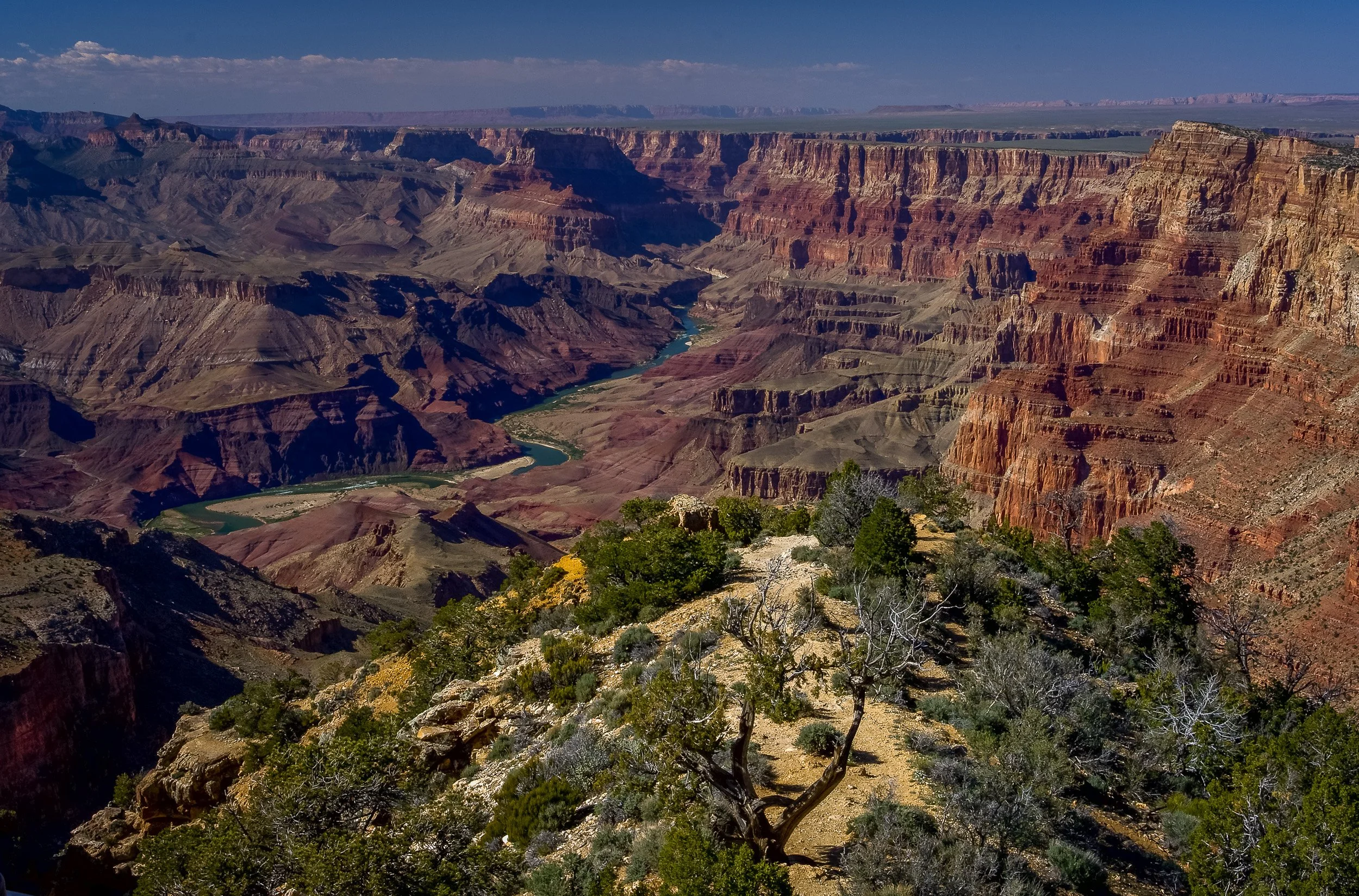
The Grand Canyon and the Colorado River seen from above, where distance, depth and layered rock formations give the landscape its overwhelming sense of scale.
In other places, scale is felt more through structure than openness. Antelope Canyon is a good example. It is not vast in the same outward sense, yet it still feels monumental. There, the impression comes through form, light and the flowing sandstone walls, where the eye moves through texture and shape rather than across an open horizon.
Light matters just as much as composition. In landscapes of this size, early or late light often gives the clearest sense of structure. Shadows become essential because they separate layers, define ridges and create shape in the space between things. Without that structure, a large scene can easily feel flatter in a photograph than it did in reality.
Viewpoint also changes everything. A high vantage point can reveal geometry and proportion, while a lower or more enclosed position can make the landscape feel heavier and more immersive. In Yosemite especially, I find that the relationship between valley floor, foreground and granite walls often matters more than any one dramatic detail on its own.
That is one of the reasons I keep returning to photographs from the American West. They remind me that scale is not only about showing something large. It is about showing distance, atmosphere, proportion and the relationship between land, light and perspective. When those elements come together, a photograph begins to carry something closer to the power of the place itself.
If you would like to explore more from this journey, you can visit the full Western USA gallery, browse more travel photography, or continue through the landscape collection.