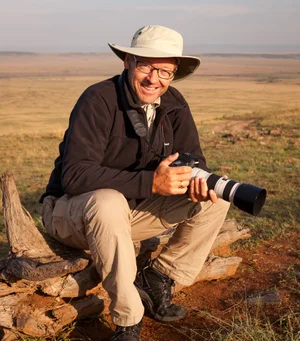
Photographing on Safari in Maasai Mara
Safari photography in Maasai Mara is exciting for the same reason photographing the northern lights is: the decisive moments arrive without warning. Animals appear suddenly, the light changes fast, and the camera needs to be ready before the scene begins, not afterwards. That is what makes it so rewarding — and why preparation matters as much as patience.
An elephant moving through backlit dust in warm evening light in Maasai Mara National Reserve, Kenya.
I have been on safari in Maasai Mara twice, and together with photographing the northern lights, it remains the most exciting part of my photography. In both cases, the same basic truth applies: you rarely control the situation yourself. The moments appear suddenly, often without warning, and if the camera is not already prepared, the opportunity can be gone before you have had time to react.
That is why fast exposure choices matter so much on safari. Animals move unexpectedly, expressions change in an instant, and a photograph often depends on whether the shutter speed is already short enough. For wildlife in motion, I usually think in terms of 1/500 second or faster. Shutter priority works especially well here, with Auto ISO allowing the camera to keep up when the light changes quickly. Continuous autofocus is equally important, so the camera can stay locked on animals that are moving through the frame.
Safari is also about far more than the so-called Big Five. Some of the strongest photographs come from behaviour rather than rarity: a lion yawning, elephants moving through dust, a giraffe turning its head at exactly the right moment, or a quieter scene where the landscape, the light and the animal all belong naturally together. Morning and evening are often the most rewarding times to photograph, and I always try to make space for wider images that include the surroundings as well as the wildlife itself.
In practical terms, safari photography really demands a proper camera and a telezoom. This is one area where a mobile phone is simply not enough if you want consistently strong results. A zoom that reaches from around 70 mm to 400 mm is ideal, and I would not want to have less than about 250 mm available. If you have two cameras, the best solution is to keep one fitted with a telezoom and the other with a wider lens, somewhere in the 20–70 mm range. That lets you move quickly between close wildlife portraits and broader landscape or environmental scenes without constantly changing lenses in dusty conditions.
Most photographs are taken from the vehicle, which brings its own practical challenges. If the car is standing still, I try to support the camera against the window frame for extra stability. Just as important is having a good dialogue with the local driver, because the best compositions often depend on being in exactly the right position. A few metres one way or the other can make a real difference to the background, the light and the strength of the scene. Patience matters just as much as equipment. Some of my best moments have come after we had been standing still for a while, simply watching and waiting, and then something suddenly happened.
Maasai people jumping in Kenya – traditional warriors performing the adumu jumping dance in colourful shúkà robes.
It is also worth remembering that the story of a safari is larger than the animals alone. The landscape, the atmosphere and the local people all belong to the experience, and in Maasai Mara the colourful clothing of the Maasai can make a striking subject in its own right. Above all, I think it is important to photograph with respect. We are the visitors there, entering the animals’ home, and the photographs become stronger when that awareness is part of the way you work.
If you would like to explore more from these journeys, you can visit the full Safari gallery, browse more travel photography, or continue to my northern lights reflections for another kind of photography shaped by patience and timing.